Compassion Contagion
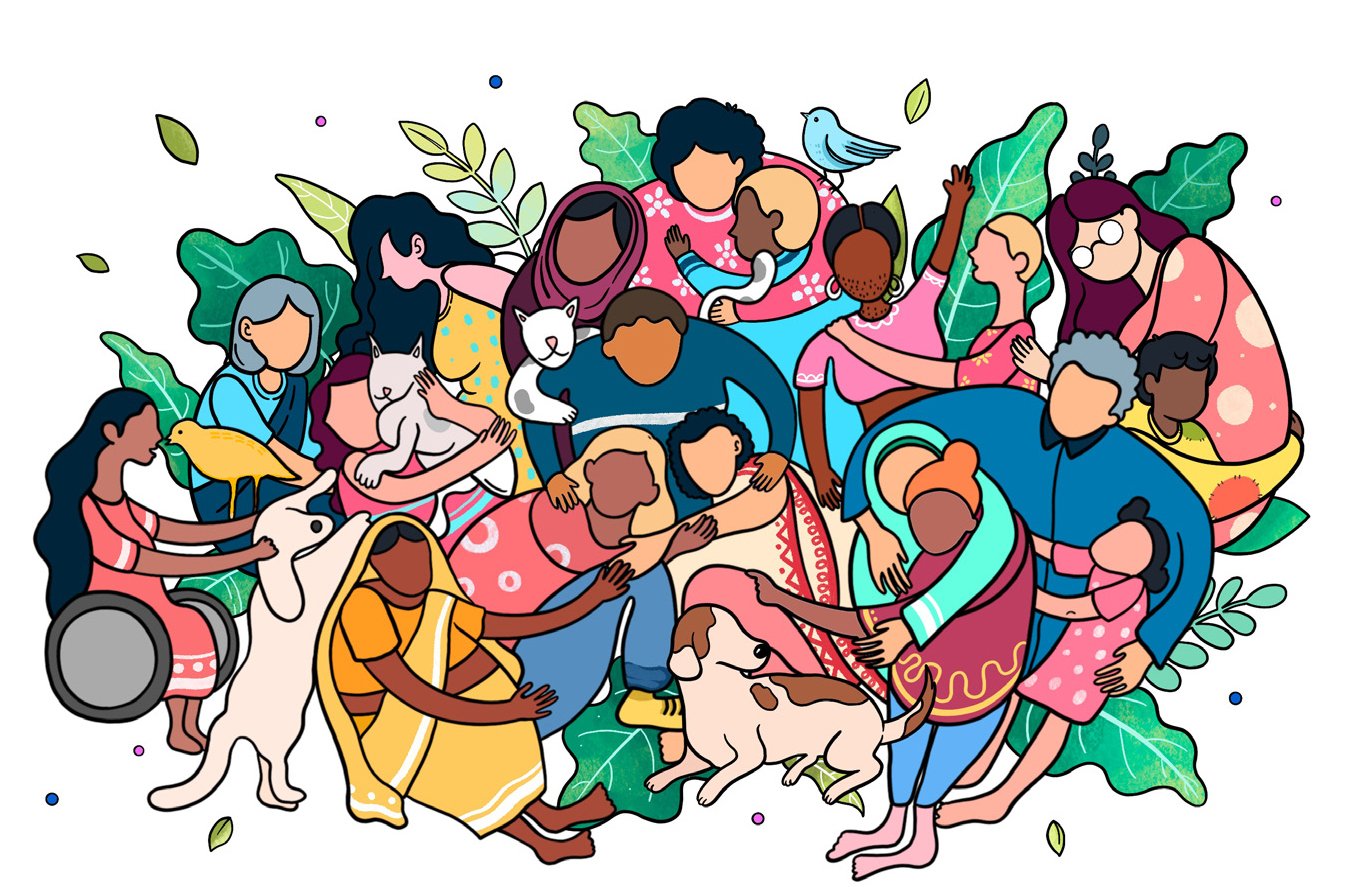
Compassion Contagion is an online archive that documents acts of compassion, resilience, solidarity and hope of ordinary citizens through stories, art and graphic narratives. It was started during the pandemic immediately after the first lockdown in collaboration with Nida Ansari, an activist. It is an attempt to shift the narrative from ‘despair’ to one of ‘hope’ .
Under this, I started an initiative called ‘Art Aid’ during the second wave – a collaboration with various artists and poets to raise funds for individuals and organisations who were doing extraordinary relief work during the pandemic.
In 2021, I collaborated with another activist- Ashik Krishnan to add Manifesto for the Future to the archive with the aim to shine light on alternate, local, sustainable models of development through the medium of folk, tribal art. graphic narratives. Food sovereignty, holistic healthcare, place-based education, community banks, media and cooperatives and reimagining of both urban and rural spaces are some of the themes that we focused on to show how it’s truly possible to create a more equitable, just and compassionate future.
The project received two grants that we received from the University of York (Centre for Applied Human Rights) and the Open Society Foundations under Arctivists.
Stitching Futures
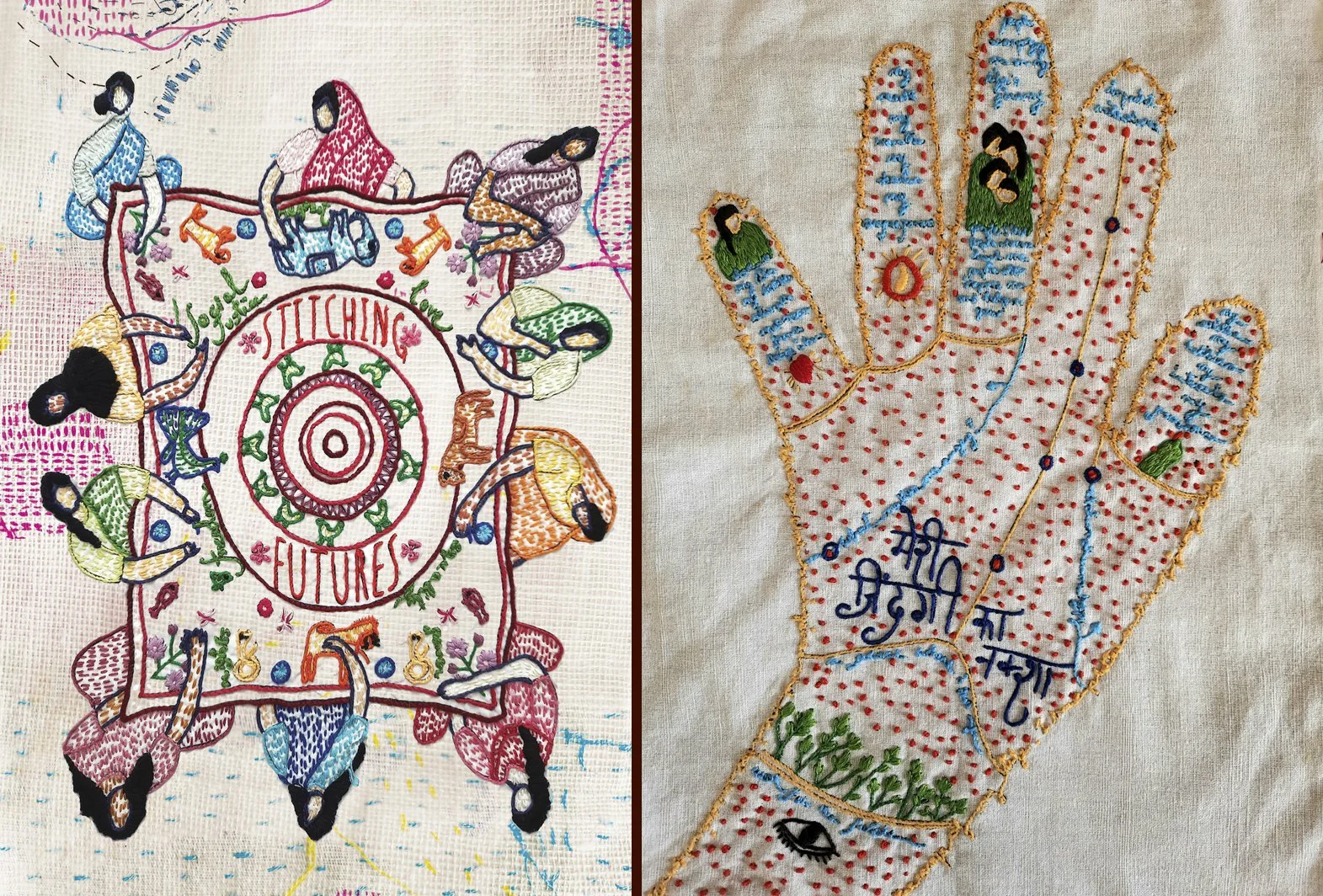
Embroidered artworks created by me and my my mom-Usha Dhingra
In 2021, I got a grant from the University of York to conceive and create The Stitching Futures toolkit- a guide for those working with various communities, in particular women and marginalized folks- in India, who wish to build solidarities and imagine alternate feminist futures in a post-COVID world. It consists of mixed media workshops that combine the healing and meditative qualities of stitching drawing and collaging; the transformative power of theatre and the values of a historically sustainable and feminist stitching practice like Kantha. Through these activities, participants are invited to stitch a shared future together while building bonds, sharing stories, and finding room to be their authentic selves.
The toolkit was created in collaboration with embroidery activist-Rubina Singh and art therapist-Roshni Singh and was tested with a two day workshop with the community women of Yusra Khan’s organization-Yellow Streets.
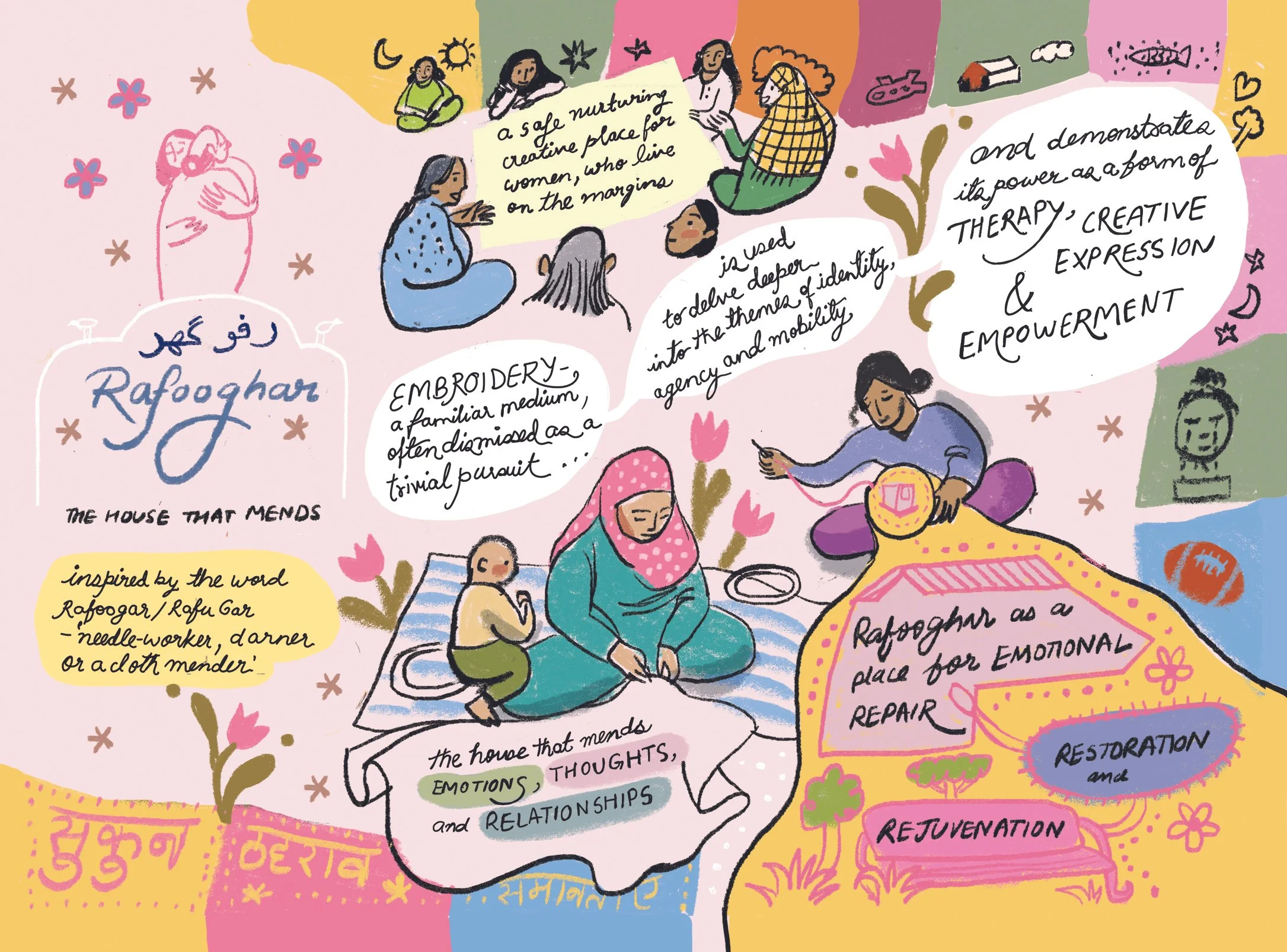
Illustration by Reshu SIngh
Rafooghar-the house that mends
(inspired from the word Rafoogar/ Rafu Gar, needle-worker, darner or a cloth mender, رفو گر)
Rafooghar is a socially engaged art practice and a community space in one of the most marginalized neigborhoods of New Delhi, India where women gather for ‘sukoon’ and fursat’ - for some moments of rest and leisure, which most women living on the margins, don’t get time or permission for. It was born out
Here, embroidery and textiles become tools for emotional repair, rejuvenation and resistance, creating room for mending that goes far beyond fabric. Sitting and stitching together becomes a way of building agency, sisterhood, solidarity, and interfaith friendships.
Rafooghar received grants from ART, University of York and Pollination grant in 2023.
This project was born out of a personal crisis. In 2021, when my father was diagnosed with Stage 4 Pancreatic Cancer, I discovered the therapeutic and healing powers of embroidery. His illness took a toll on the family, particularly my mother, and I wanted to find a way to keep her calm, engaged and motivated. Knowing that she used to embroider in her younger days and found passion in it, I decided to order an embroidery kit. Embroidery not only brought a sense of purpose to my mother but also helped her manage her anxiety during this challenging time. Intrigued by its effects, I decided to learn embroidery myself. Amidst the endless chemo sessions, tests, and side effects, as well as our never-ending caregiving duties, embroidery became our refuge. While researching on embroidery's therapeutic potential, I realised that despite being frequently dismissed as a trivial domestic pursuit, embroidery has demonstrated its power, time and again, as a tool not only for therapy but also for protest, advocacy and social change. Rafooghar emerged as an experiment to test this idea: could stitching become a medium for collective healing, storytelling, and social transformation? What began as a deeply personal act of care has since grown into a socially engaged art practice and community space, nurtured in collaboration with social worker’s Yusra Khan’s organization-Yellow Streets, Artreach India, art educator-Shivangi Singh, art therapist-Roshni Bhatia and community members- Foziya Shahista, Shabeena Ji, Jyoti, Anjali, Saniya, Ruma, Gulafsha and Hariom.
Rafooghar started at Yellow Streets in Shaheen Bagh and has been housed there since 2023. Since its inception, however, it has continued to find new homes and collaborators. The dream is for Rafooghar to exist in many houses…both temporary and permanent, by carrying its practice to other communities, cities, and countries. Over the years, Rafooghar has travelled to the Participatory Design Conference in Malaysia, the AWID Forum in Thailand, the Alt Shift Festival in Germany, as well as numerous cities across India. It has also grown through long-term community engagements, including a six-month collaboration with LP4Y, a youth organization, and a year-long engagement with the women of Nizamuddin Basti in collaboration with Aagaaz Theatre Trust. Both initiatives have been supported by the Kiran Nadar Museum of Art, led by women from Rafooghar's first cohort at Yellow Streets.
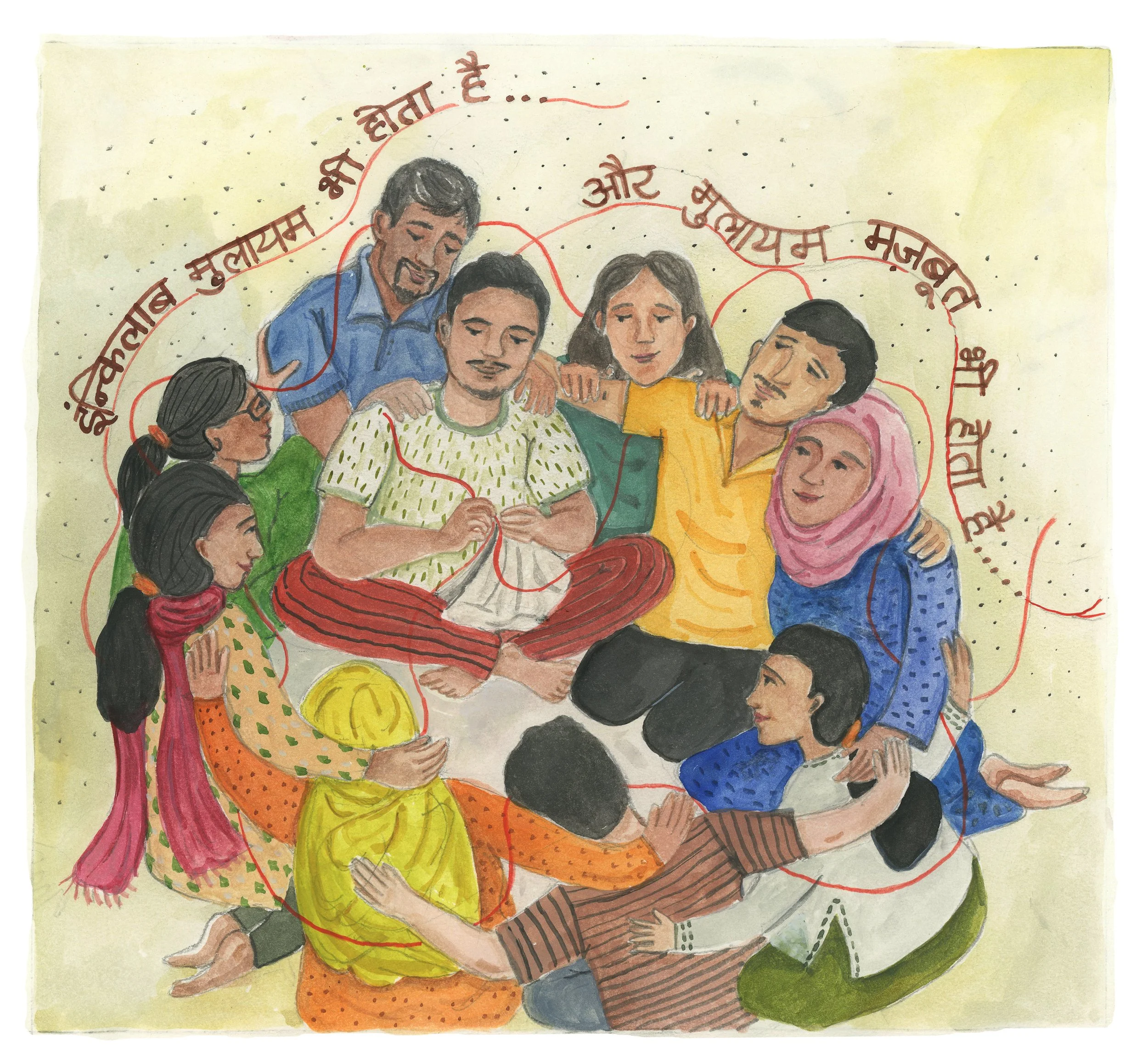
Illustration by Toshi Singh
Meethi Baradari ( Sweet Brotherhood)
“हमारे पति अपना गुस्सा हम पर निकालते हैं, और हम अपना गुस्सा अपने बच्चों पर निकालते हैं। मारपीट का यह सिलसिला ऐसे ही चलता रहता है... कभी खत्म नहीं होता।"
(Our husbands take their anger out on us, and we take it out on our children. This cycle of violence never ends...)
-Roshan ji (a participant at Rafooghar)
Meethi Baradari is an attempt to interrupt this cycle by using the power of art, theatre and textiles to engage with the youth in marginalized nrigborhoods and to question harmful gender norms. Here, care, gentleness, and vulnerability are not seen as weaknesses, but as essential human qualities.
Conceived at Rafooghar, the project draws inspiration from Hariom’s story, a young participant who was bullied and mockingly called ‘meetha’ simply because he loved stitching, helped with household work, and expressed himself with softness and care. Instead of allowing that word to remain an insult, Meethi Baradari reclaims it as a celebration of compassion, sensitivity, and the courage to be oneself.
A generational cycle of anger, frustration, and violence can only begin to end when we acknowledge it, speak about it, and unlearn it together.
The project got the Futures in Formation Grant (FICA–Serendipity Arts Foundation), enabling Meethi Baradari to run a year long module with the youth of the community and bring their work into the public realm through a community exhibition in a functioning local gym.
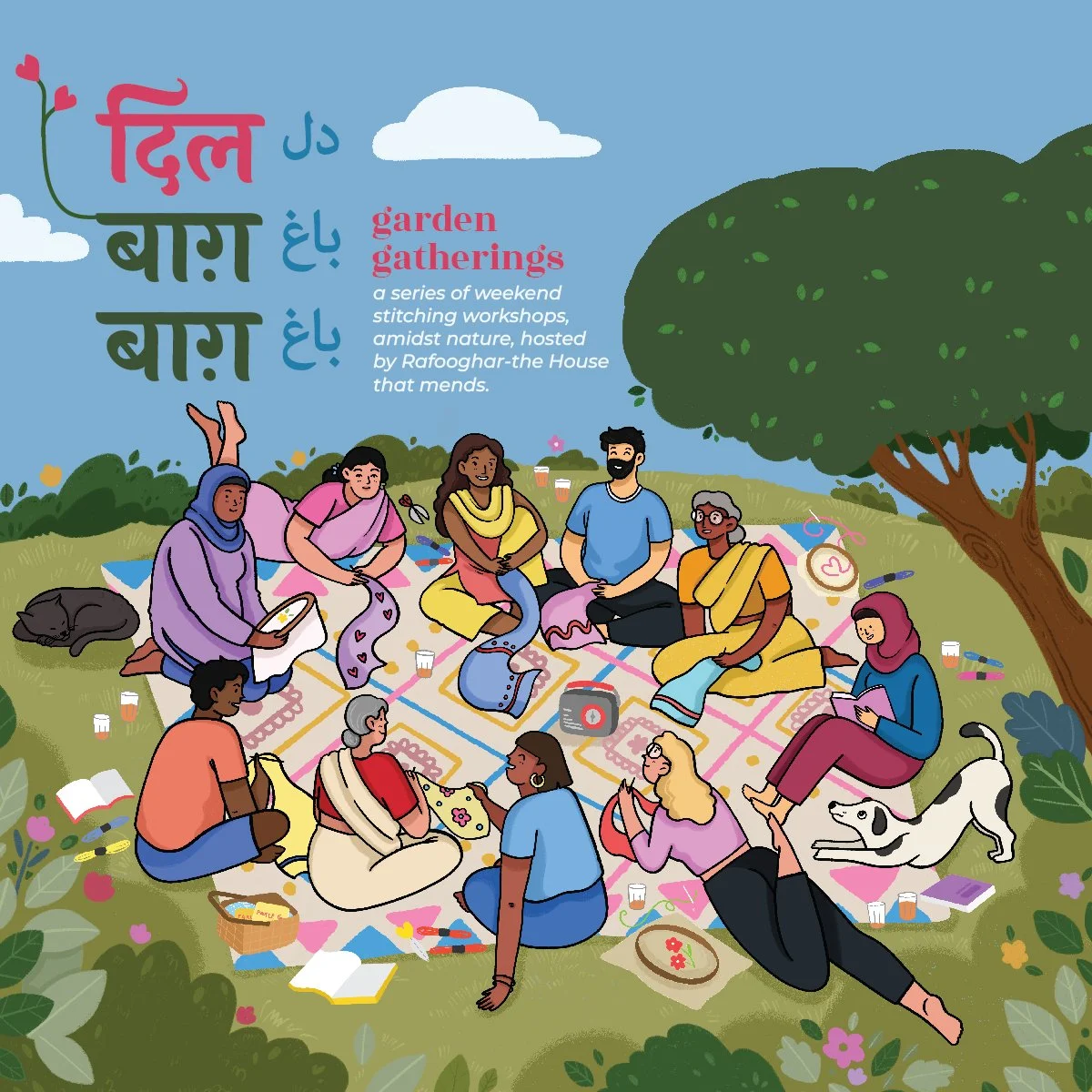
Illustration by Annie Hazarika
Dil Bagh Bagh - Garden Gatherings
Dil Bagh Bagh loosely translates as “the heart is so happy that it has become a blooming garden. Through these gatherings, the joy of stitching amidst nature is shared with others. It is also a deliberate attempt to bring embroidery out from the confines of the domestic sphere, making it a more public and visible activity.
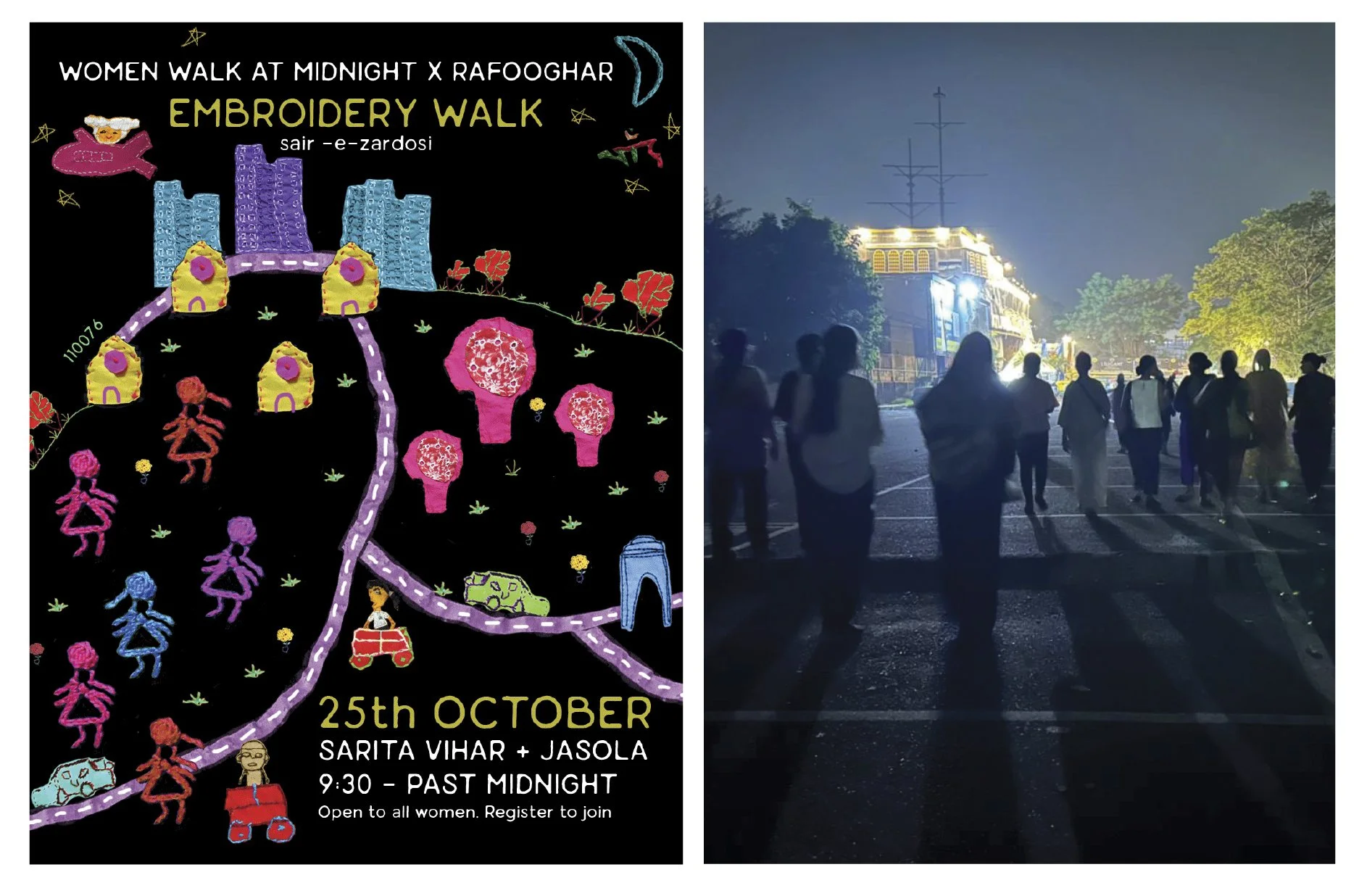
Sair-E-Zardozi + Sair Sapata
Sair-e-Zardozi and Sair Sapata (Rafooghar * WWAM collaboration) are late- night walking and stitching gatherings led by the women of Rafooghar, who conduct these walks in their neigborhoods, taking participants through the rhythms of their everyday lives and routines. They also venture into new parts of the city, exploring and experiencing spaces they have never accessed before. Embroidery, traditionally associated with the domestic and private sphere, becomes a way of occupying and engaging with public space. These gatherings attempt to expand the possibilities of embroidery by using it as tool for mobility, visibility and claiming space.
Women Walk at Midnight (WWAM) is a practice of women walking, together, at night on the streets of our cities. Started by theatre artist Mallika Taneja and led by a team of volunteers these late-night walks across cities reimagins the relationship women have with the city, with walking, and with the night. It insists that these are not just sites of danger, but also of joy, curiosity, and freedom.